
How Do Mechanic’s Liens Work in Colorado?
A Colorado mechanic’s lien can allow contractors, subcontractors, suppliers, and certain other construction professionals to secure payment for labor, materials, equipment, or services provided to improve real property.
Mechanic’s liens can be powerful, but Colorado has strict requirements governing who may claim a lien, what notices must be served, when the lien statement must be recorded, and how long the claimant has to file a lawsuit to enforce the lien.
For property owners, a mechanic’s lien can also create significant problems even when the owner believes the contractor performed defective or incomplete work—or even when the owner has already paid the general contractor.
This page explains the Colorado mechanic’s lien process, common filing deadlines, lien enforcement, and important considerations for both property owners and construction professionals.
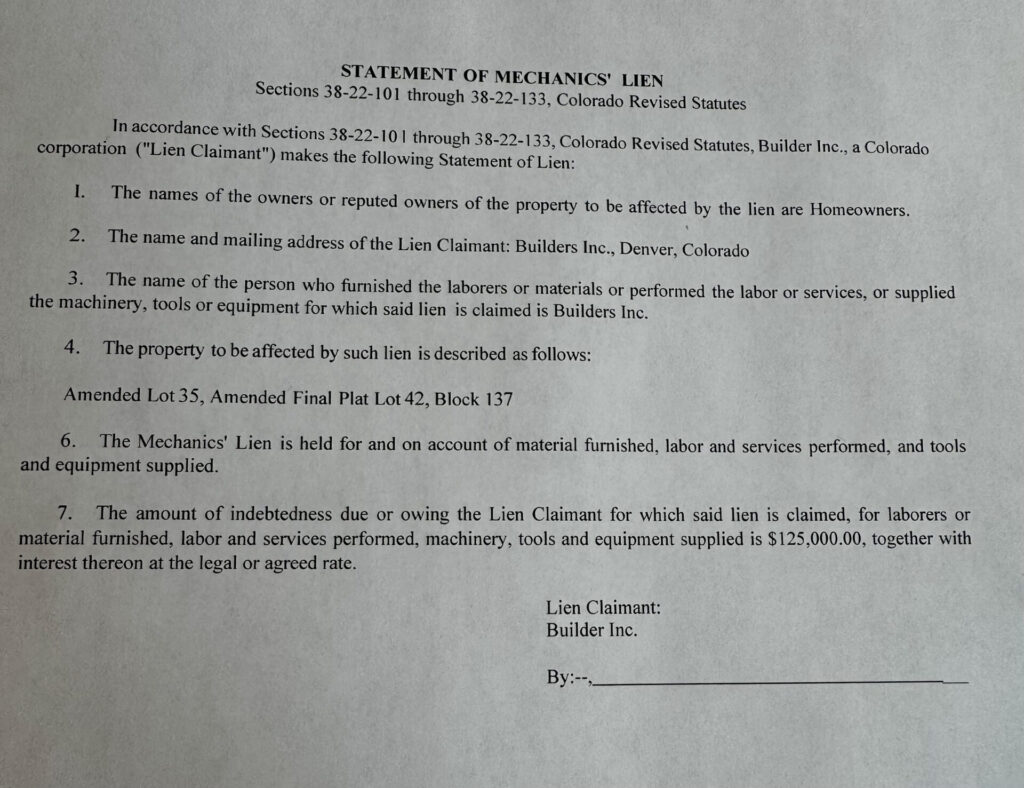
What is a Mechanic’s Lien?
A mechanic’s lien is a statutory claim against real property for qualifying unpaid labor, materials, equipment, or services used to improve the property.
When properly perfected, the lien can give the claimant a security interest in the improved property and may ultimately be enforced through a lawsuit seeking foreclosure of the lien.
Because mechanic’s lien rights are created by statute, complying with Colorado’s notice, filing, timing, and enforcement requirements is important.
What is the Deadline for Filing the Mechanic’s Lien?
For many Colorado mechanic’s lien claimants, the lien statement generally must be recorded within four months after the claimant last performed labor or furnished laborers or materials.
Different deadlines can apply to certain types of lien claimants. For example, Colorado law provides a shorter deadline for some claims based solely on labor performed by the day or piece. Because determining the correct deadline can be fact-specific, a potential lien claimant should identify the applicable deadline as early as possible.
Who Can File a Mechanic’s Lien?
In Colorado, a variety of parties involved in the improvement of a property can file a mechanic’s lien, including:
- General contractors
- Subcontractors
- Material suppliers
- Equipment lessors
- Architects, engineers, and other design professionals
Filing a Mechanic’s Lien in Colorado
To file a mechanic’s lien in Colorado, the following steps must be followed:
Serve a Notice of Intent to File a Lien Statement
Before recording a Colorado mechanic’s lien, the claimant generally must serve a Notice of Intent to File a Lien Statement at least 10 days before the lien statement is recorded.
Colorado law generally requires the notice to be served on the owner or reputed owner of the property, or the owner’s agent, and on the principal or prime contractor or the contractor’s agent.
For many lien claimants, the lien statement generally must be recorded within four months after the claimant last performed labor or furnished laborers or materials. Different deadlines may apply depending on the nature of the claimant and work performed.
- The name and address of the claimant
- The name of the property owner
- A description of the property
- A statement of the amount due
- The date when the work or materials were last provided
Enforcing a Mechanic’s Lien in Colorado
Recording a mechanic’s lien does not by itself result in payment. A claimant who wants to enforce the lien generally must commence a lawsuit within the time required by Colorado law.
Under C.R.S. § 38-22-110, a mechanic’s lien generally will not continue to encumber the property beyond the statutory six-month enforcement period unless an action to enforce the lien is commenced and notice that the action has been commenced is recorded with the county clerk and recorder within the required time.
If the lien is established and successfully foreclosed, the court may order the property sold to satisfy the lien.
Protecting Yourself from Mechanic’s Liens
For Property Owners:
Ensure that all contractors and subcontractors are paid on time. Request lien waivers from contractors and suppliers as they are paid. Consider using joint checks to pay both the contractor and subcontractor simultaneously.
Consult with an attorney if a mechanic’s lien has been filed against your property. In some cases, the fact that a lien exists may not require immediate action or any action at all. But in other cases, time is of the essence.
For Construction Professionals:
Keep detailed records of all work performed and materials supplied.
Provide timely notices and adhere to filing deadlines.
Consult with an attorney to ensure compliance with all legal requirements.
Need Help With a Colorado Mechanic’s Lien?
Colorado mechanic’s lien law contains strict notice, recording, and enforcement requirements. Missing an applicable deadline or failing to comply with statutory requirements can affect whether a lien is valid or enforceable.
Sweeney Construction Law represents contractors, subcontractors, construction professionals, homeowners, and property owners in mechanic’s lien and construction payment disputes throughout Colorado.
If you need assistance filing, enforcing, challenging, or responding to a mechanic’s lien, contact Sweeney Construction Law at 303-634-2274.
Disclaimer
The information provided on this page is for informational purposes only and does not constitute legal advice. Please consult with a qualified attorney for advice regarding your specific situation.


